pig's whisper noun
1. A very short time.
2. A low or nearly inaudible whisper.
[Of uncertain origin. Earliest documented use: 1780.]
An illustration from the book "The Tale of Pigling Bland", 1913 https://wordsmith.org/words/images/pigs_whisper_large.jpg
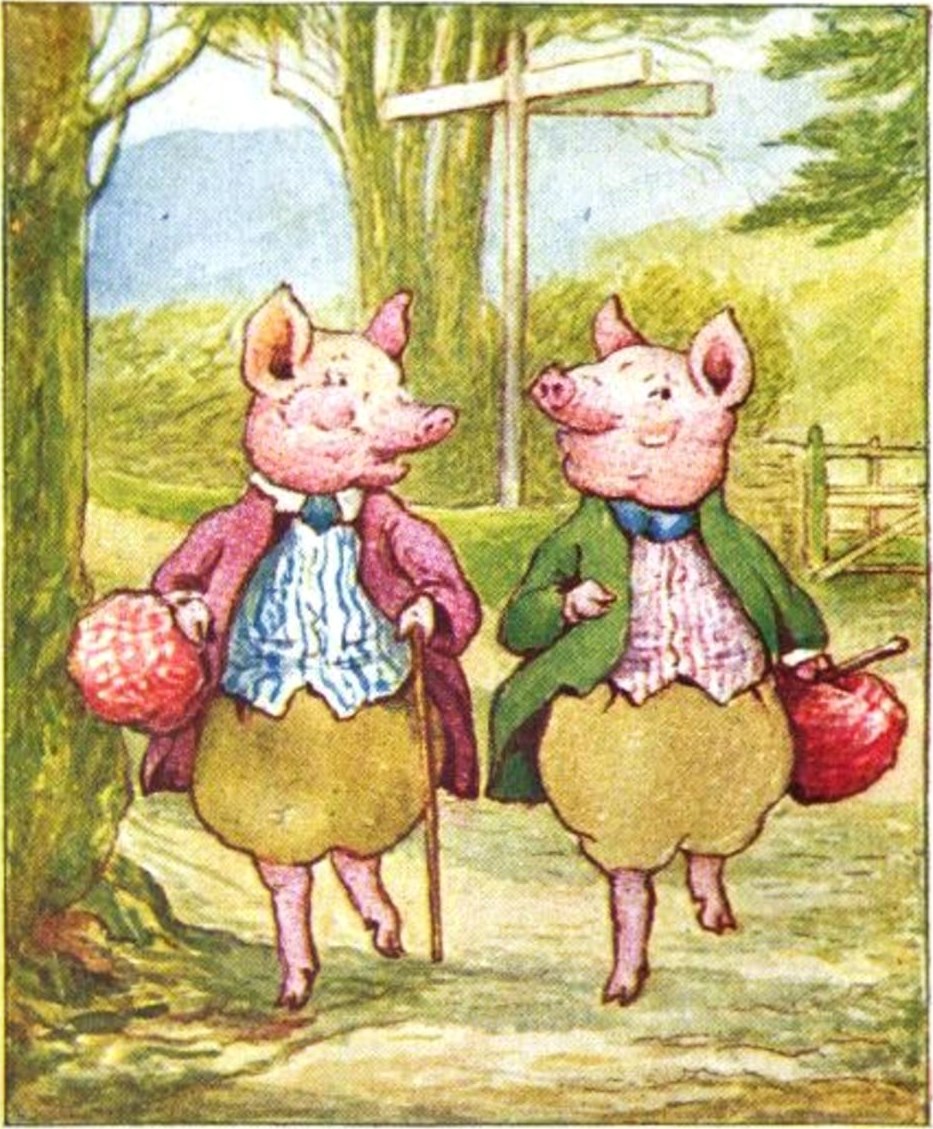
It's not clear how a pig's whisper came to be associated with a very short time or a whisper. A pig is not known for whispering, though a grunt can be brief enough. A variant of today's term is a pig's whisker. Wordsmith May 14, 2026
Invisible Cities is a novel by the Italian writer Italo Calvino. It was published in Italy in 1972 by Giulio Einaudi Editore. The book is framed as a conversation between the Mongol emperor Kublai Khan, and Marco Polo. The majority of the book consists of brief prose poems describing 55 fictitious cities that are narrated by Polo, many of which can be read as commentary on culture, language, time, memory, death, or human experience generally. Short dialogues between Kublai and Polo are interspersed every five to ten cities discussing the same topics. https://en.wikipedia.org/wiki/Invisible_Cities
Italo Calvino (1923–1985)
was an Italian novelist and short story writer.
His best-known works include the Our Ancestors trilogy
(1952–1959), the Cosmicomics collection
of short stories (1965), and the novels Invisible
Cities (1972) and If on a
winter's night a traveler (1979). Admired in Britain, Australia and the United
States, Calvino was the most translated contemporary Italian writer at the time
of his death. Italo Calvino was born
in Santiago de las Vegas, a
suburb of Havana, Cuba,
in 1923. In
1925, less than two years after Calvino's birth, the family returned to Italy
and settled permanently in Sanremo on the Ligurian coast. Calvino's brother Floriano, who became a
distinguished geologist, was born in 1927. See list of Calvino’s writings,
films about Calvino, and awards at https://en.wikipedia.org/wiki/Italo_Calvino
Tristram Coffin (or Coffyn) (c. 1609–1681) was an immigrant to Massachusetts from England. He came to the Massachusetts colony with his family in 1642. In 1659 he led a group of investors that bought Nantucket from Thomas Mayhew for thirty pounds and two beaver hats. He became a prominent citizen of the settlement. Some descendants became loyalists and migrated to Canada. Other descendants migrated away from colonial America's eastern seaports and settled in Quaker communities in places such as North Carolina. While some descendants were engaged in the slave trade and illegally smuggling slaves into the US or Canada after the international slave trade was banned in 1808, others were leading influential anti-slavery and abolitionists movements in multiple states across the country. https://en.wikipedia.org/wiki/Tristram_Coffin_(settler)
Chicago fine dining destination Smyth has been named the continent’s best restaurant in the 2026 edition of North America’s 50 Best Restaurants. On a starry night in New Orleans, dining luminaries from coast to coast were honored among their peers. Eunji Lee of New York’s singular Lysée was recognized as North America’s Best Pastry Chef, while Aldo Sohm of Le Bernardin and Aldo Sohm Wine Bar was declared North America’s Best Sommelier. Mashama Bailey from The Grey Restaurant in Savannah, Ga., was named North America’s Best Female Chef. Find the full list of the 50 restaurants honored in 2026 at https://blog.resy.com/2026/05/worlds-50-best-north-america/
May 31, 2026